How AI is Reshaping Medical Research: A New Tool for Automated Literature Screening
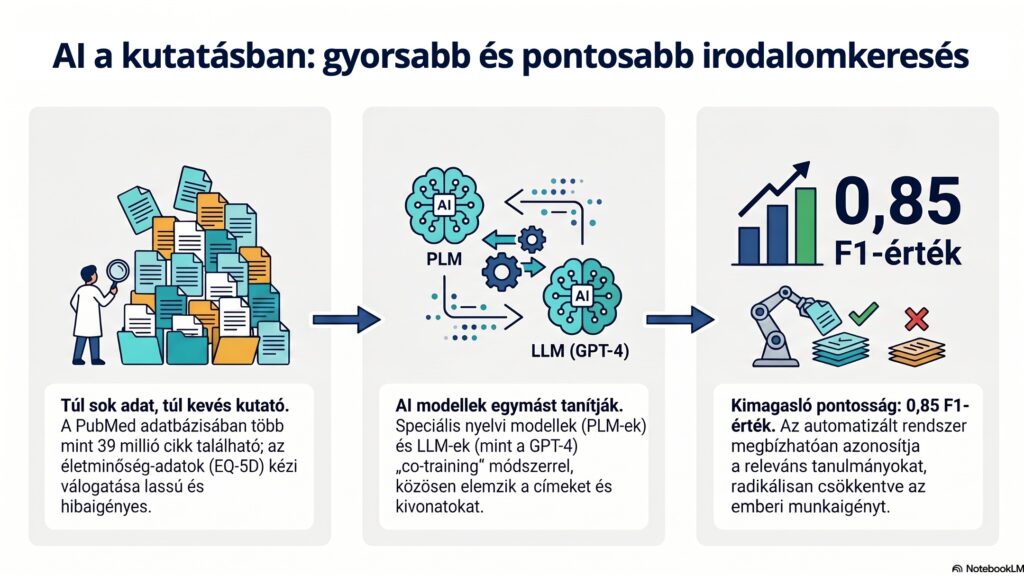
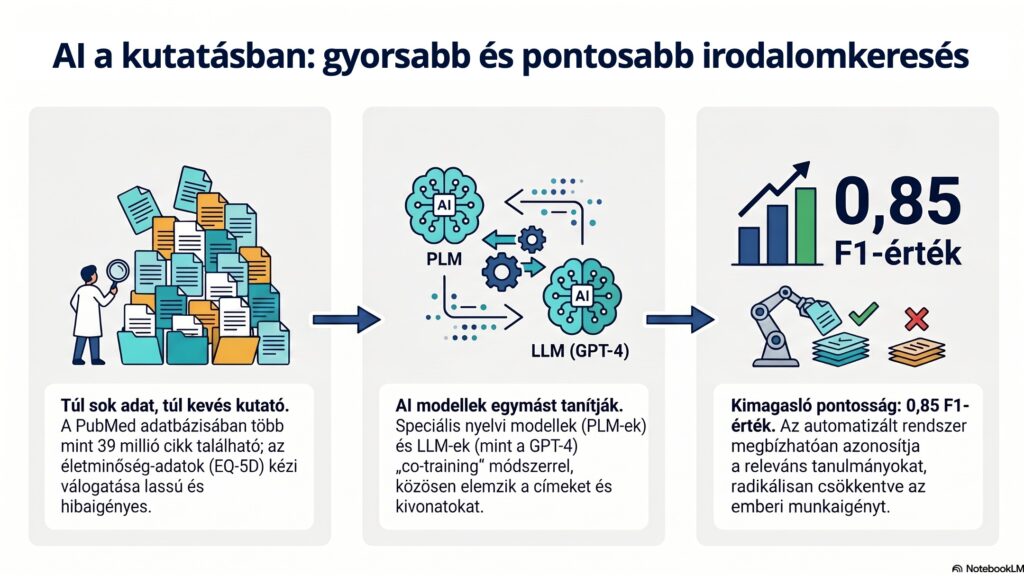
Finding specific medical studies, like those using the EQ-5D quality-of-life questionnaire, among millions of PubMed articles is a slow and exhausting manual process. To solve this, researchers developed an automated system utilizing advanced artificial intelligence and pre-trained language models (like BioBERT) to read article metadata and classify them automatically.
By combining different AI models and utilizing Large Language Models (like GPT and Claude), the system achieved an impressive 0.85 F1-score accuracy in identifying relevant health studies, significantly reducing the manual workload.
The major breakthrough of this study is the innovative “co-training” framework, where AI models essentially teach each other using large amounts of unlabeled text, proving highly effective even when initial human-labeled data is scarce.
This innovative approach strongly reinforces Obuda University’s strategic commitment to artificial intelligence, demonstrating how cutting-edge machine learning and automated text analysis can directly accelerate healthcare research and drive future medical innovations.
Keywords
artificial intelligence, medical research, machine learning, text analysis, healthcare
Further Details
Rostam, Zhyar Rzgar K., Márta Péntek, János Tibor Czere, Zsombor Zrubka, László Gulácsi, and Gábor Kertész. “Automated Classification of EQ-5D Literature in PubMed Using Multi-Phase Learning and LLM-Assisted Co-Training.” IEEE Access (2023).
Abstract The EQ-5D is a widely used tool for measuring health-related quality of life (HRQoL) to support clinical, economic, and policy decision making. Manually classifying the growing volume of literature reporting EQ-5D data for systematic literature reviews is a challenging, inefficient, and labor-intensive task. To address this, we propose a comprehensive classification framework utilizing pre-trained language models (PLMs), including BERT, SciBERT, BioBERT, PubMedBERT, and BioLinkBERT, to categorize PubMed records based on whether the article reports EQ-5D data using article metadata (titles, abstracts, and keywords). We examine three learning approaches: supervised learning, semi-supervised learning with pseudo-labeling, and a co-training strategy with and without Large Language Model (LLM) assistance (GPT and Claude) in pseudo-label generation. We introduce a confidence-based ensembling within the co-training framework to improve classification reliability and robustness. This study provides a systematic multi-phase evaluation of supervised, semi-supervised, and co-training paradigms on PubMed records using different input configurations and investigates model performance in stages with 200 labeled samples and an expanded unlabeled dataset through iterative pseudo-labeling, while benchmarking across models. The results show that the co-training approach achieved the highest performance, with an F1-score of up to 0.85. Performance is reported using multi-seed evaluation with mean ± standard deviation and 95% confidence intervals. LLM-assisted co-training improves weaker model pairs but may degrade performance for already strong model combinations and reduce the number of high-confidence pseudo-labeled samples due to confidence thresholds. LLMs used with ensemble and semi-supervised approaches provide an effective framework for EQ-5D literature screening under limited labeled data.
Keywords EQ-5D, Health-Related Quality of Life, Large Language Model, PubMed, BioNLP, Co-Training, LLM-Assisted Pseudo-Labeling, Systematic Literature Screening.
The original publication is available at the following link: https://doi.org/10.1109/ACCESS.2023.1120000