Muscle-Controlled Omnidirectional Robot: Bringing Advanced Engineering Labs to Students’ Homes
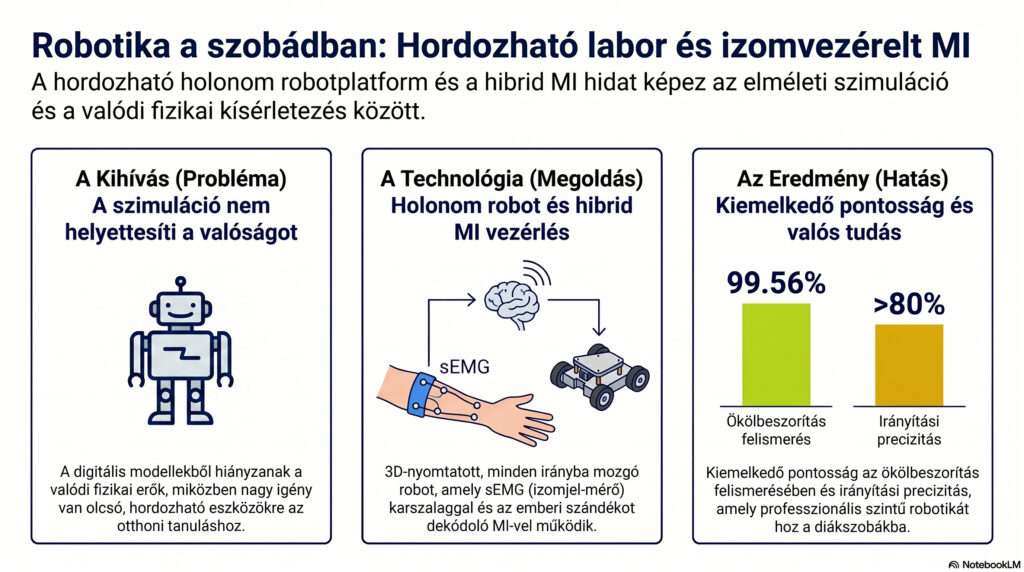
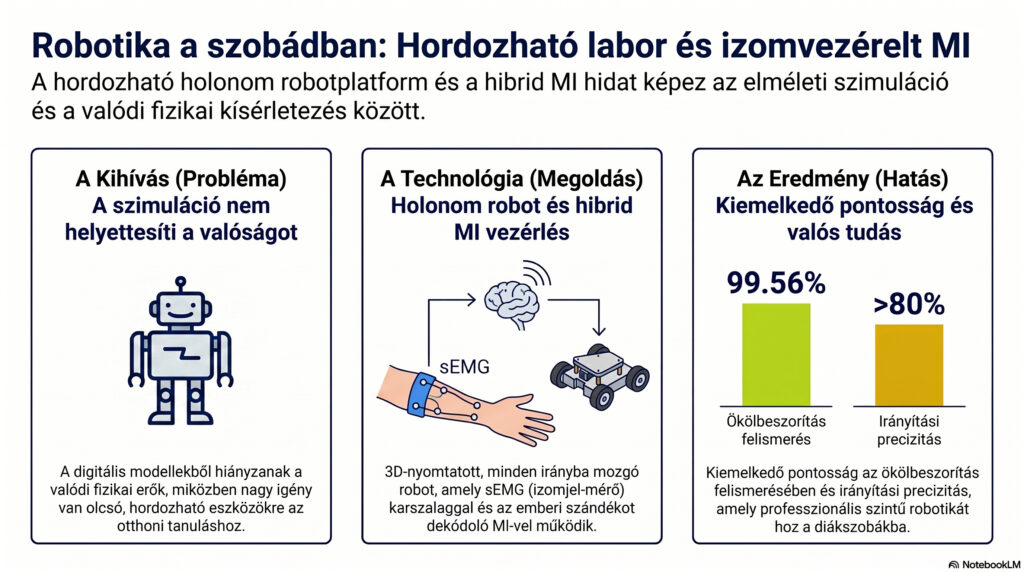
Following the pandemic, engineering students needed practical ways to conduct complex hardware experiments at home, as software simulations simply cannot fully replicate real-world physical challenges like friction or sensor noise.
To solve this, researchers designed a low-cost, modular omnidirectional robot that can move freely in any direction using a 3D-printed chassis. Instead of using a traditional joystick, the robot is intuitively driven by a smart armband that reads the electrical signals of the user’s forearm muscles (sEMG).
By utilizing a hybrid artificial intelligence model, the system successfully decodes these muscle signals into specific, real-time movement commands. It identifies complex hand gestures with impressive reliability, reaching an accuracy of 99.56% for detecting a clenched fist, and over 80% for directional movements.
By combining complex movement capabilities with AI-driven teleoperation in an affordable package, this scalable tool fundamentally redefines remote STEM education. Furthermore, it strongly reinforces Obuda University’s strategic commitment to advanced robotics, showcasing how intelligent, accessible systems can deeply empower the next generation of engineers.
Keywords educational robot, muscle control, home laboratory, artificial intelligence, advanced robotics
Further Details
Noboa, Erick Alexander, Lourdes Ruiz, György Eigner, and Péter Galambos. “Portable Holonomic Educational Robot Platform for Home Laboratory—Study Case: AI-Based Electromyography Control.” Technologies, 2026.
Abstract The post-pandemic evolution of education involving mechatronics and machine learning has shifted the demand for robotic hardware from centralized laboratories to accessible laboratories in home environments. This paper presents a portable three-wheeled holo-nomic robotic platform designed for remote research and home office experimentation. The proposed system utilizes a modular design and low-cost philosophy comprising a custom embedded control system driven by an ESP32-WROOM microcontroller, which manages a closed-loop PID velocity controller using Hall effect feedback from three DC micromotors. In contrast, external nodes allow the reception, conditioning, and classification of 8-channel surface electromyography (sEMG) data sampled at 500 Hz. To address the non-stationarity and stochastic noise in raw sEMG signals, this study implements a hybrid Deep Learn-ing (DL) architecture that complements 2D Convolutional Neural Networks (CNN) for spatial feature extraction with Long Short-Term Memory (LSTM) networks for temporal context awareness. This model decodes the neuromuscular intent of the user into real-time holonomic velocity vectors, achieving validation accuracies of 80.51% for horizontal move-ment, 84.86% for vertical translation, and 99.56% for the Fist/no-Fist state. By synthesizing advanced AI-based teleoperation with a portable design, this study establishes a scalable framework for the next generation of “laboratory-at-home” educational tools and research regardless of physical location.
Keywords holonomic mobile platform, home-education, deep learning, electromyography, teleoperation
The original publication is available at the following link: https://doi.org/10.3390/technologies1400308