How Industrial Work Can Stress Us Out: A New Computer Model to Keep Workers Healthy and Productive
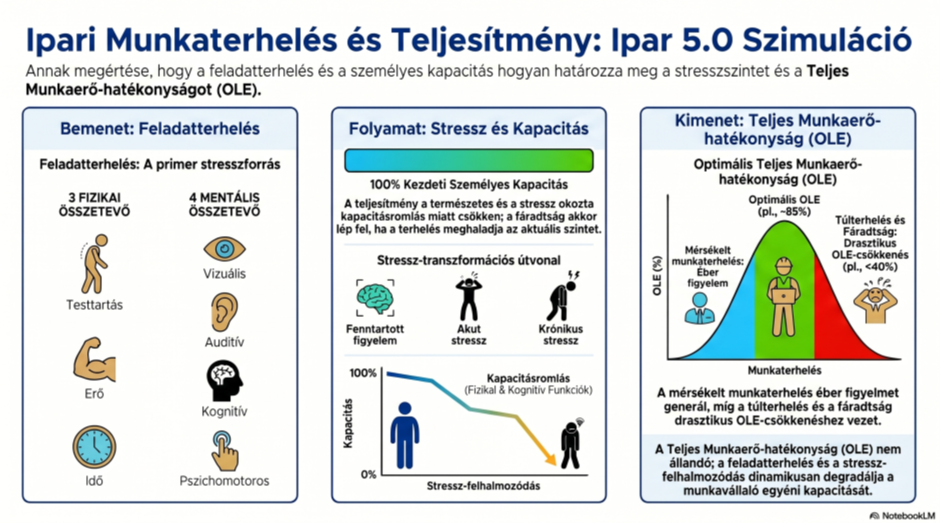
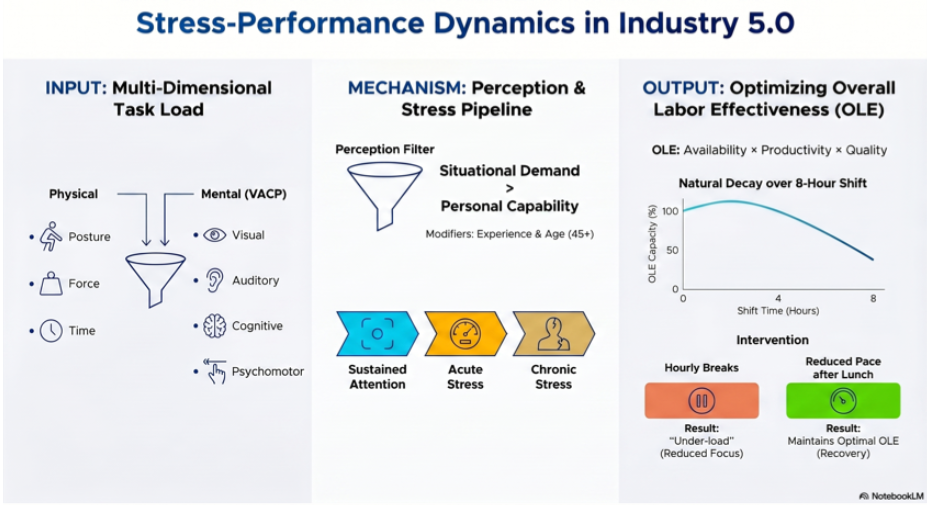
Industrial workers frequently face demanding physical and mental tasks that lead to psychological stress, burnout, and fatigue, which ultimately hurts their daily performance and health. Existing methods for managing this problem often ignore how specific parts of the work content—like uncomfortable posture, required force, and cognitive demands—directly trigger this stress cycle.
To solve this, researchers developed a computer simulation model that mathematically tracks how a worker’s stress levels rise and fall in real time during a shift. By acting like a “digital twin,” the system compares the specific demands of the job with the individual worker’s personal capacity and work environment (such as poor lighting or strict time pressures) to predict exactly when they will feel overloaded.
The simulation tests revealed that continuous high workloads quickly drain a worker’s capacity and trigger harmful “acute stress,” which severely degrades their performance, while carefully timed interventions like slowing down the work pace allow the muscles to recover. Interestingly, introducing too many extra breaks can actually drop a worker’s “sustained attention” too low, making them under-prepared for the next task and ironically causing more stress.
This provides a vital tool for the Industry 5.0 (I5.0) framework, a European initiative which strongly prioritizes worker well-being. It gives engineers and managers a scientific way to design safer workstations and test out scheduling interventions before real workers ever get exhausted.
Keywords Workplace stress, workload, mental and physical fatigue, performance simulation, Industry 5.0, digital twin
Further details Tran, Tuan-anh, Tamás Ruppert, György Eigner, and János Abonyi. 2026. “Conceptual qualitative system dynamics model for simulation of perceived workload, stress and performance from industrial work content.” PLoS One 21 (5): e0347030.
Abstract Workload and psychological stress, which industrial workers perceived as stressors, affected their performance after they were exposed to the work content. A model simulating the stress-performance of a working individual is a beneficial tool for work task design and production management, enabling long-term Human Resource Development. Current models and concepts lack the construction of work-content components, human centricity, and the mechanism of stress transformation and effect; therefore not able to reproduce subtle human behaviors. This paper formulates this problem with a multi-disciplinary literature review, and proposes a conceptual qualitative system dynamics model to simulate the stress and performance of workers in a given work environment and conditions. By replicating the changes in work content with associated effects, human-centric solutions and interventions can be designed. A use case in the Vensim environment with different simulated scenarios returned behavior and tendency in the outputs that aligned with phenomena reported in relevant studies. The model enables analysis of human factors in complex manufacturing systems, especially the effect of work content on individual workload-stress perception, benefiting future development of Human Digital Twins. This research calls for experiments and clinical trials to strengthen the existing associations between model factors and more effort for developing realistic mechanisms for modeling human factors in Industry 5.0.
Keywords workload, psychological stress, human performance, simulation, system dynamics, Industry 5.0, Human Digital Twin
The original publication can be accessed at the following link: https://doi.org/10.1371/journal.pone.0347030