Digital Twins for Diabetes: A New Mathematical Model to Predict Blood Sugar Accurately
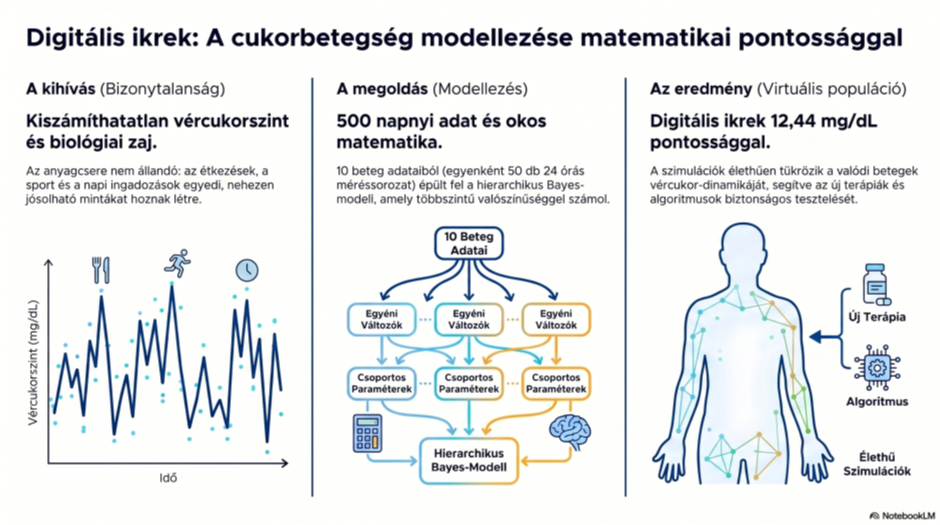
Predicting blood sugar levels for people with Type 1 Diabetes is a massive challenge because the human body’s processes are always changing and influenced by unpredictable factors like stress, daily metabolism shifts, and physical activity.
Researchers built a hierarchical Bayesian model—a complex mathematical system based on probability—that analyzed 500 individual 24-hour sets of data from 10 different patients, tracking their daily insulin, meals, heart rate, and exercise.
Using this new mathematical method, the average difference between the real blood sugar levels and the computer’s predictions was only 12.44 mg/dL, showing a highly accurate match between the real patients and the simulated data.
The main breakthrough is the model’s ability to authentically simulate physiological uncertainties and daily fluctuations, meaning these “digital twins” (virtual copies of patients) can help safely test new treatments and improve automated blood sugar control systems.
Keywords
1-es típusú cukorbetegség, matematikai modellezés, digitális iker, vércukorszint előrejelzés, virtuális beteg, okoseszközök az egészségügyben.
Further details
Siket, Mate, Levente Kovacs, and Gyorgy Eigner. “Stochastic virtual population in type 1 diabetes.” PLoS One 21, no. 2 (2026): e0341034.
Abstract Accurate, reliable, and efficient estimation of blood glucose dynamics from real-world data is challenging due to the time-varying nature, high uncertainty, and nonlinear interplay of complex processes. In this study, we propose and investigate a stochastic representation of a virtual population by fitting a hierarchical Bayesian model. In total, we use 500 24h-long sequences, 50 from each of the 10 patients with type 1 diabetes on multiple daily injection therapy. We model uncertainty on multiple levels, in physiology and in self-reported events, and take into account intra- and inter-day variability, and the effect of physical activity as well. The root-mean-square error between the glucose measurements and the mean of the posterior predictive distribution using the fitted low-rank multivariate normal guide is 12.44 mg/dL. We show that the posterior distributions can be used to simulate realistic intra-, and interday variability in terms of the investigated patient cohort.
Keywords type 1 diabetes, stochastic modeling, virtual population, Bayesian model, blood glucose dynamics, digital twin
The original publication can be accessed at the following link: https://doi.org/10.1371/journal.pone.0341034