The Right Amount Matters: Uncovering the Truth About Foam Hand Sanitizer Dispensers
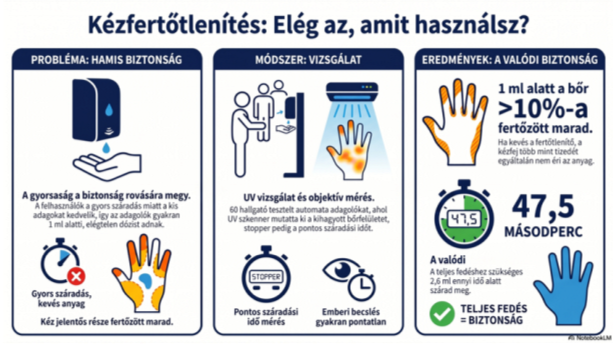
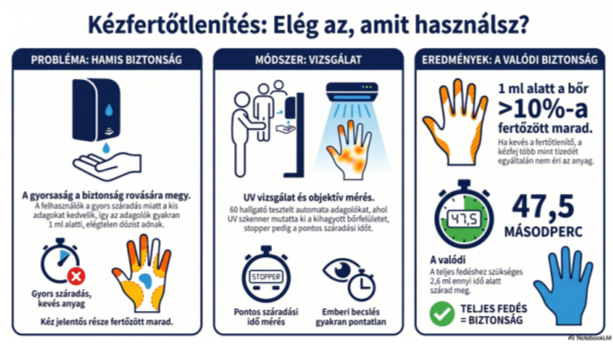
Proper hand hygiene is essential for preventing the spread of hospital infections, but healthcare workers generally prefer using small amounts of sanitizer because it dries much faster. Reacting to this trend, manufacturers increasingly design touch-free dispensers to release smaller doses, raising critical questions about whether these preset amounts actually provide enough foam to cover the hands completely.
To investigate this, researchers asked sixty medical students to test three automatic foam dispensers while using technological tools to objectively measure both drying time and hand coverage. The study revealed a strong direct relationship between the applied volume and effective coverage: using less than 1 mL of sanitizer left over 10% of the hand’s surface entirely unwashed, while larger volumes significantly improved coverage at the cost of a much longer drying time.
A critical finding of this study is that people cannot accurately guess if they have received enough sanitizer, proving that human intuition is an unreliable measure for infection control. Therefore, the exact volume a dispenser releases must be considered a top-priority quality indicator when hospitals purchase hygiene equipment.
By using precise evaluation tools to solve real-world healthcare challenges, this research strongly reflects Obuda University’s dedication to the field of medical technology. Advancing objective, data-driven hygiene solutions demonstrates how engineering innovation can directly enhance patient safety and modernize clinical practices.
Keywords hand hygiene, medical technology, automatic dispenser, patient safety, hospital infections.
Further Details
Bansaghi, S., C. Voniatis, N. M. Smith, J. J. McNulty, J. W. Arbogast, and T. Haidegger. “Apply enough!—Quality of hand hygiene determined by the volume of handrub provided by touch-free foam dispensers.” Journal of Hospital Infection 171 (2026): 219-226.
Abstract Applying alcohol-based handrubs (ABHRs) can be a key factor in controlling the spread of infection yet only if the proper amount of an effective hand rub formulation is used. Healthcare workers often prefer to apply small amounts of ABHRs since it dries faster. In response to this market preference, dispenser manufacturers tend to design their dispensers to dose small amounts. This study aims to investigate whether manufacturers’ preset volume is suitable to achieve complete coverage. Medical students were asked to perform hand hygiene using foam-format hand rubs from three different wall-mounted, automatic dispensers. Drying time and hand coverage were objectively measured at each hand hygiene event. Participants were also asked to qualitatively assess the amount of ABHRs received. Sixty medical students tried all three dispensers, applying either one or two doses from each. Hand coverage strongly correlated with the applied ABHR volume. When less than 1 mL of handrub was applied, more than 10% of the hand surface was missed. Drying time appeared to be a limiting factor: when 2.6 mL of handrub was applied, the average drying time was 47.5 s. The participants’ perception of the amount of ABHRs received was inconsistent. As the dispensed ABHR volume determined the coverage achieved, it should be among the key indicators of quality when selecting a dispenser for installation. Participants frequently misjudged whether the received hand rub amount was appropriate, suggesting that we cannot rely on people’s intuition. Higher volumes cover the hands better but require longer drying times, which can impede compliance.
Keywords Hand hygiene, Foam handrub, ABHR volume, Product dose
The original publication is available at the following link: https://doi.org/10.1016/j.jhin.2025.11.016