How Autonomous Vehicles Learn to Navigate Off-Road: A New AI-Driven Approach to Faster Path Planning
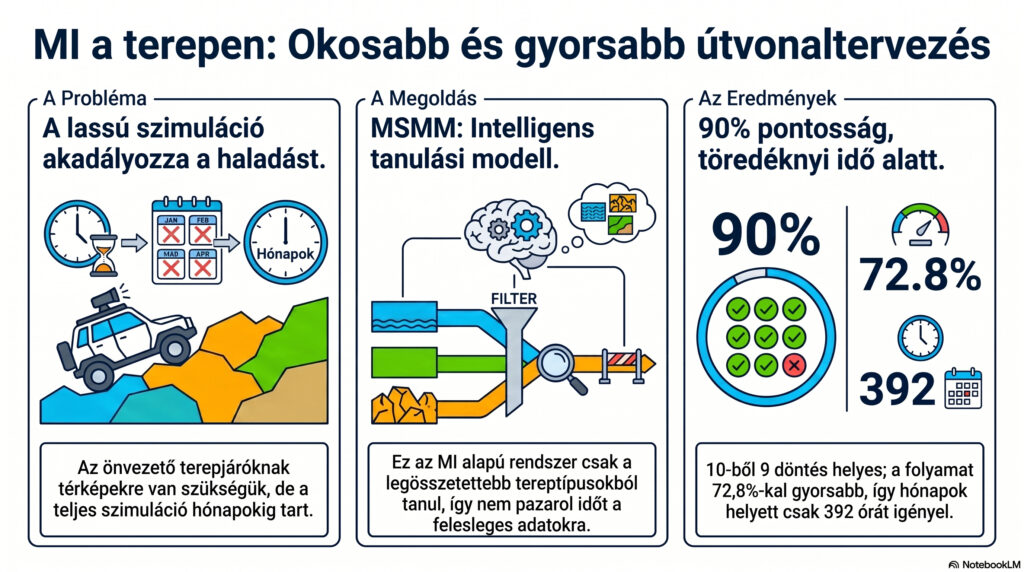
Navigating off-road environments is a massive challenge for autonomous vehicles. Terrain conditions like soil composition and slopes vary constantly, and traditional physical simulations are computationally too expensive and slow to map large areas efficiently,.
To solve this, researchers developed the MSMM framework, a novel artificial intelligence approach using multi-strategy active learning. Instead of simulating every single terrain grid, the system smartly selects only the most uncertain and valuable data points to train its neural networks,.
The method’s true novelty lies in its dual-strategy and dual-check verification system, ensuring both high speed and reliability,. As a result, the model maps terrain navigability with 90% accuracy while reducing simulation time by 72.8%, dramatically outperforming previous algorithms in terms of computational efficiency.
This breakthrough strongly exemplifies Obuda University’s strategic commitment to advanced robotics. By significantly enhancing the decision-making speed and efficiency of off-road autonomous systems, this research directly contributes to the next generation of highly capable robotic vehicles navigating complex environments,.
Keywords
Autonomous vehicles, Artificial intelligence, Off-road navigation, Machine learning, Advanced robotics.
Further Details
Hua, Chen, Jie Chen, Biao Yu, Jinde Cao, and Imre J. Rudas. “MSMM: Multiple Strategy Fusion Enhanced Global Mobility Prediction Model for Off-Road Autonomous Vehicles.” 2025.
Abstract With the development of numerical simulation technology, simulation techniques based on the discrete element method have been widely applied to predict the mobility of autonomous vehicles in off-road environments. However, such methods require significant computational costs due to the exhaustive simulation needed to obtain the mobility of each terrain grid. Therefore, this paper proposes a multi-strategy fusion enhanced model for predicting vehicle mobility. Firstly, a classification boundary data augmentation algorithm based on the initial dataset is proposed. This algorithm detects boundary planes of different mobility classifications in the existing dataset and randomly augments mobility data on these boundary planes. Then, based on the entropy bagging algorithm combined with unsupervised learning sample selection strategies, controversial data are filtered and further simulated for calibration before being added to the sample set for training. Subsequently, the prediction results of the basic classification model are validated based on the verification classification model to achieve the validation of pseudo-labels. This process is repeated until the maximum iteration count is reached. Finally, a global mobility map is generated based on the calibrated samples. Simulation experiments demonstrate the superiority of the proposed method in terms of both accuracy and computational efficiency.
Keywords Autonomous vehicle, mobility map, simulation, active learning, multiple strategy.
The original publication is available at the following link: https://doi.org/10.1109/TVT.2026.3682512