Hogyan tanulnak meg az önvezető autók terepen navigálni? Egy új, mesterséges intelligenciával támogatott módszer a gyorsabb útvonaltervezésért
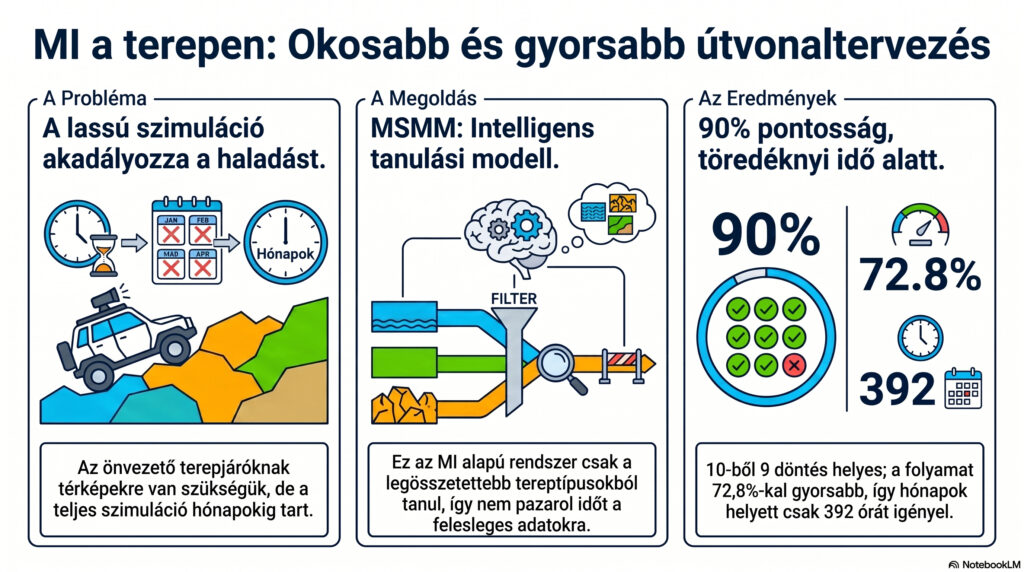
Az önvezető járművek terepen történő navigációja hatalmas kihívás. A talaj minősége és a lejtők meredeksége folyamatosan változik, a hagyományos fizikai szimulációk pedig túl lassúak és számításigényesek ahhoz, hogy a gépek gyorsan dönthessenek a járhatóságról,.
Erre a problémára kínál megoldást egy új, mesterséges intelligencián alapuló megközelítés (MSMM). Ahelyett, hogy a szoftver minden egyes lehetséges tereppontot végigszámolna, a rendszer aktív tanulást használva okosan kiválasztja a legbizonytalanabb területeket, és csak ezekből tanul,.
A kutatás eredményei lenyűgözőek: az új módszerrel a terepviszonyok 90%-os pontosságú feltérképezése 72,8%-kal kevesebb időt vesz igénybe, mint a teljes terület hagyományos szimulációja.
A modell újdonsága egy kettős ellenőrzési rendszerben és több tanulási stratégia ötvözésében rejlik. Ez biztosítja, hogy az algoritmus ne csak drasztikusan gyorsabb legyen, hanem rendkívül megbízhatóan, hibák nélkül jósolja meg a jármű mozgásképességét,.
Ez a fejlesztés kiválóan példázza az Óbudai Egyetem elkötelezettségét a fejlett robotika és a mesterséges intelligencia kutatása iránt, hiszen a modern önvezető rendszerek hatékonyságának és döntéshozatali sebességének növelése a jövő intelligens gépeinek alapját jelenti,.
Kulcsszavak
Önvezető járművek, Mesterséges intelligencia, Terepnavigáció, Gépi tanulás, Fejlett robotika.
További részletek
Hua, Chen, Jie Chen, Biao Yu, Jinde Cao, and Imre J. Rudas. „MSMM: Multiple Strategy Fusion Enhanced Global Mobility Prediction Model for Off-Road Autonomous Vehicles.” 2025.
Abstract With the development of numerical simulation technology, simulation techniques based on the discrete element method have been widely applied to predict the mobility of autonomous vehicles in off-road environments. However, such methods require significant computational costs due to the exhaustive simulation needed to obtain the mobility of each terrain grid. Therefore, this paper proposes a multi-strategy fusion enhanced model for predicting vehicle mobility. Firstly, a classification boundary data augmentation algorithm based on the initial dataset is proposed. This algorithm detects boundary planes of different mobility classifications in the existing dataset and randomly augments mobility data on these boundary planes. Then, based on the entropy bagging algorithm combined with unsupervised learning sample selection strategies, controversial data are filtered and further simulated for calibration before being added to the sample set for training. Subsequently, the prediction results of the basic classification model are validated based on the verification classification model to achieve the validation of pseudo-labels. This process is repeated until the maximum iteration count is reached. Finally, a global mobility map is generated based on the calibrated samples. Simulation experiments demonstrate the superiority of the proposed method in terms of both accuracy and computational efficiency.
Keywords Autonomous vehicle, mobility map, simulation, active learning, multiple strategy.
Az eredeti közlemény elérhető az alábbi linkre kattintva: https://doi.org/10.1109/TVT.2026.3682512
További híreink
Hogyan tanulnak meg az önvezető autók terepen navigálni? Egy új, mesterséges intelligenciával támogatott módszer a gyorsabb útvonaltervezésért
Az önvezető járművek terepen történő navigációja hatalmas kihívás. A talaj minősége és a lejtők meredeksége folyamatosan változik, a hagyományos fizikai szimulációk pedig túl lassúak és számításigényesek ahhoz, hogy a gépek gyorsan dönthessenek a járhatóságról,.
Erre a problémára kínál megoldást egy új, mesterséges intelligencián alapuló megközelítés (MSMM). Ahelyett, hogy a szoftver minden egyes lehetséges tereppontot végigszámolna, a rendszer aktív tanulást használva okosan kiválasztja a legbizonytalanabb területeket, és csak ezekből tanul,.
A kutatás eredményei lenyűgözőek: az új módszerrel a terepviszonyok 90%-os pontosságú feltérképezése 72,8%-kal kevesebb időt vesz igénybe, mint a teljes terület hagyományos szimulációja.
A modell újdonsága egy kettős ellenőrzési rendszerben és több tanulási stratégia ötvözésében rejlik. Ez biztosítja, hogy az algoritmus ne csak drasztikusan gyorsabb legyen, hanem rendkívül megbízhatóan, hibák nélkül jósolja meg a jármű mozgásképességét,.
Ez a fejlesztés kiválóan példázza az Óbudai Egyetem elkötelezettségét a fejlett robotika és a mesterséges intelligencia kutatása iránt, hiszen a modern önvezető rendszerek hatékonyságának és döntéshozatali sebességének növelése a jövő intelligens gépeinek alapját jelenti,.
Kulcsszavak
Önvezető járművek, Mesterséges intelligencia, Terepnavigáció, Gépi tanulás, Fejlett robotika.
További részletek
Hua, Chen, Jie Chen, Biao Yu, Jinde Cao, and Imre J. Rudas. „MSMM: Multiple Strategy Fusion Enhanced Global Mobility Prediction Model for Off-Road Autonomous Vehicles.” 2025.
Abstract With the development of numerical simulation technology, simulation techniques based on the discrete element method have been widely applied to predict the mobility of autonomous vehicles in off-road environments. However, such methods require significant computational costs due to the exhaustive simulation needed to obtain the mobility of each terrain grid. Therefore, this paper proposes a multi-strategy fusion enhanced model for predicting vehicle mobility. Firstly, a classification boundary data augmentation algorithm based on the initial dataset is proposed. This algorithm detects boundary planes of different mobility classifications in the existing dataset and randomly augments mobility data on these boundary planes. Then, based on the entropy bagging algorithm combined with unsupervised learning sample selection strategies, controversial data are filtered and further simulated for calibration before being added to the sample set for training. Subsequently, the prediction results of the basic classification model are validated based on the verification classification model to achieve the validation of pseudo-labels. This process is repeated until the maximum iteration count is reached. Finally, a global mobility map is generated based on the calibrated samples. Simulation experiments demonstrate the superiority of the proposed method in terms of both accuracy and computational efficiency.
Keywords Autonomous vehicle, mobility map, simulation, active learning, multiple strategy.
Az eredeti közlemény elérhető az alábbi linkre kattintva: https://doi.org/10.1109/TVT.2026.3682512